# Dear Brothers and Sisters in the Love of Jesus Christ!
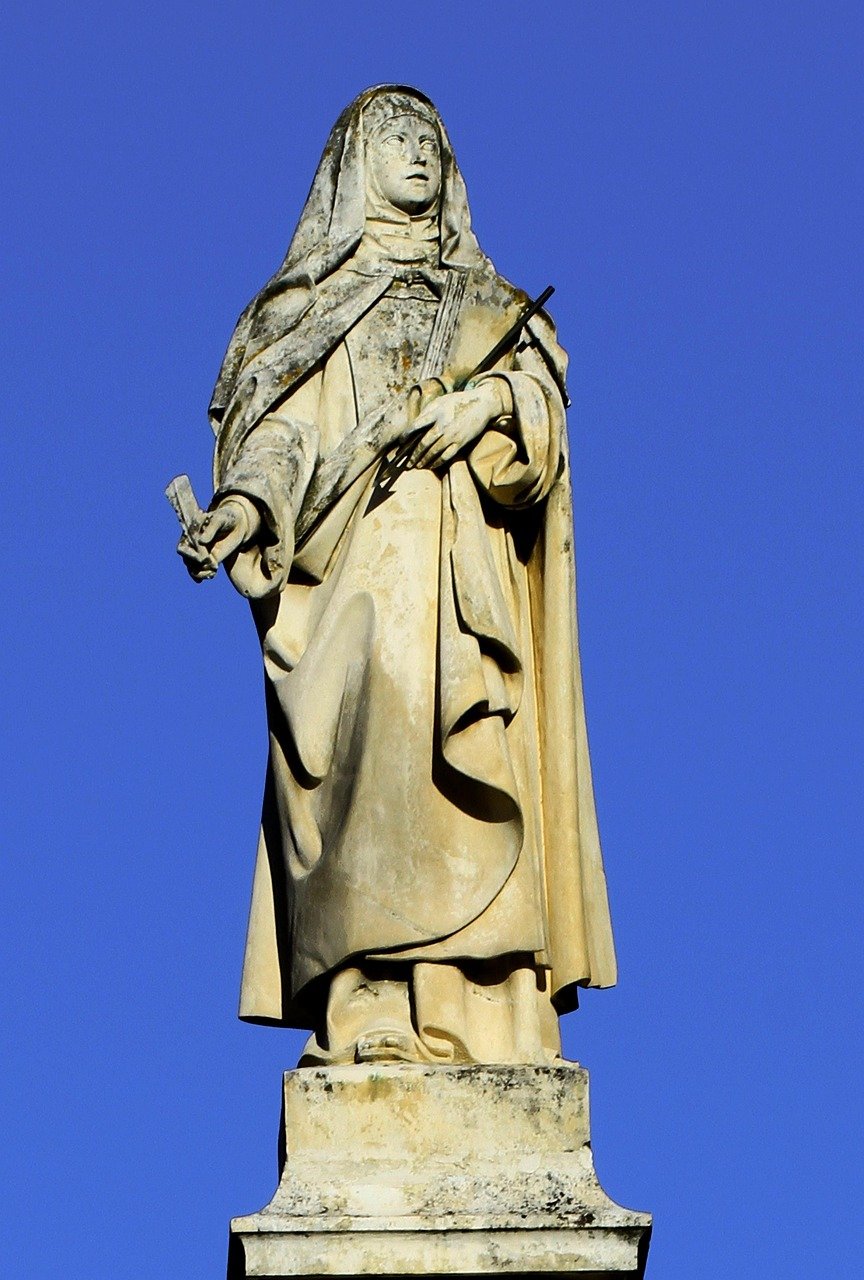
Today, October 15, Mother Church celebrates the **Memorial Feast of Saint Teresa of Ávila**, a Spanish Carmelite nun and Doctor of the Church, offering her veneration and honour through the celebration of the Holy Mass in her memory.
I dedicate this brief historical account of the saint to the Carmelite sisters who, within the four walls of their convents, pray for us day and night.
Our saint is also known as **Saint Teresa of Jesus (St. Teresa of Jesus)**. She played a significant role in the renewal of the Catholic Church. She was a mystic and theologian. Together with Saint John of the Cross, she established the Discalced Carmelite Order for women. She wrote several books on contemplative prayer and the renewal of the Catholic Church. She is one of the Doctors of the Catholic Church and was the **first woman to receive the title of Doctor of the Church**.
Our saint was born on March 28, 1515, in the town of **Ávila, Spain**, to devout Catholic parents, **Alonso Sánchez de Cepeda** and **Beatriz de Ahumada**. Because she was born in Ávila, she came to be known as Teresa of Ávila. She had eleven siblings, and she was raised as a beloved child of her parents.
Even as a young child, she believed that, through a vision, she had come to know that she would suffer greatly before her death. She shared this belief with others.
Our saint was brought up by her parents in a deeply devout Catholic atmosphere. Following their guidance, she read the lives of the saints and resolved to live like them. Accordingly, she embraced a simple way of life.
At the age of seven, she ran away from home with her brother, hoping to go among the Moors, preach the faith, and die as a martyr. However, her uncle found her and brought her back home.
At the age of twelve, she lost her mother. Her grief was immeasurable. She knelt before an image of the Blessed Virgin Mary, wept bitterly, and begged Our Lady to be her mother from that moment onward. Saint Teresa herself is quoted as saying:
*“I threw myself down in despair before an image of the Mother of God. With many tears, I implored the Holy Virgin to become my mother now. Uttered with the simplicity of a child, this prayer was heard. From that hour on, I never prayed to the Virgin in vain.”*
For a short period, our saint lived according to worldly ways. Later, she experienced a change of heart and, in accordance with her desire, entered the Carmelite convent in **1535**, embracing religious life.
Later, she became seriously ill and remained unconscious for four days, in a coma-like state. Afterward, she was afflicted with paralysis. During this period, she experienced a vision of Our Lord Jesus suffering on the Cross.
At the age of forty-five, she again had a vision in which she foresaw that she would undergo great suffering before her death. As a result, she left that convent and was permitted to live separately in another convent.
There, she led a life of prayer under very strict religious discipline. **Prayer became the very breath of her life.** Through her deep life of prayer, she went on to establish another religious convent.
All the convents she founded followed a strict and simple way of life. The sisters practised silence, went barefoot, ate very simple food, and gave the highest priority to a life of prayer.
Saint Teresa experienced visions on many occasions and recorded her spiritual experiences in more than 400 letters. She came to be known among the people of Spain as a mystic associated with extraordinary visions. Through these spiritual experiences, she contributed to the life and renewal of the Church in many ways.
Later, Saint Teresa became the superior of her religious community and introduced several reforms within the order. She played a significant role in the reform of the Catholic Church. She also wrote many spiritual books, including her autobiography.
Our saint endured the hardships, illnesses, and sufferings that came her way with great patience. Finally, after becoming seriously ill, she departed this earthly life on **October 4, 1582, at the age of sixty-seven**, to behold face to face the Lord whom she had encountered in her visions.
Our saint is **one of the four women Doctors of the Catholic Church**:
1. Saint Teresa of Ávila
2. Saint Catherine of Siena
3. Saint Thérèse of Lisieux
4. Saint Hildegard of Bingen
We have already learned about the other three women Doctors of the Church in our earlier reflections.
Saint Teresa was canonised in **1622**. She was also the first woman to be proclaimed a Doctor of the Church.
Engage & Support the Essay
Applaud, broadcast insights to all social networks with 1-click, or follow Coach Saluja.
FOLLOWING COACH
LIKE ARTICLE0 Appreciations
SHARE ESSAYPublish to All Socials
FOLLOWINGActive VIP Member
SUBSCRIBESunday Journal
QUICK BROADCAST:
Leave a Comment
Thanks for your comment! It will be reviewed.
Sr. Saluja OSMCERTIFIED LIFE STRATEGIST & EXECUTIVE MENTOR
Dedicated to guiding ambitious individuals, entrepreneurs, and seekers toward clarity, resilience, and actionable life mastery. Over 10+ years of mentoring.